This essay was originally published on my Substack.
There were days when I wanted to take a day off because life was happening to me, too.
I still showed up.
There were days when a student had cussed me out the day before.
I still showed up.
There were days when I felt singled out or harassed by school administrators.
I still showed up.
There were days when people couldn’t understand why students who struggled or acted out in other classrooms seemed to thrive in mine.
I still showed up.
And there were days when parents couldn’t understand why their children wanted to stay after school.
I still showed up.
For a long time, I didn’t have the language to explain why I kept doing it. But eventually, I understood.
This was my calling.
Not because teaching was easy. Not because I had all the answers. And certainly not because everything in my personal life was going according to plan.
I knew it was my calling because no matter what was happening around me, this was the one place I continued to show up.
Maybe some of that determination came from growing up in East Cleveland, Ohio.
I understood early that some people are handed opportunities while others have to figure out how to create their own.
You learn to fight through things. You learn to figure it out. You try something, fail, get back up, and try again.
And sometimes, all you need is somebody who believes you’re capable of doing more.
When Someone Else Decides What You’re Capable Of
Years later, when the Atlanta Journal-Constitution featured my story, I had another opportunity to reflect on where I started and how I got here.
One part of my journey has always stayed with me.
I remember being told by a guidance counselor that I wasn’t college material.
Cue Jay-Z’s “So Ambitious.” You know the part where he questions how adults speak to kids, especially when all he did was speak in class? That one hits differently when you’ve been the child on the receiving end of somebody else’s low expectations. And whoever decided I wasn’t college material? I hope she’s somewhere near a speaker right now. LOL.
Imagine that.
Someone whose entire job was to help me see my possibilities had already decided I didn’t have any.
She wasn’t my teacher. She didn’t know my work, my effort, or what I was capable of building. She was the person standing at the door to what came next, and she decided I didn’t need to walk through it.
I walked through it anyway.
But here’s what I can’t let go of.
She wasn’t a bad algorithm. She was a person. A person with the power to decide which students got pointed toward college and which ones didn’t.
And she wasn’t the only one.
So when people ask me whether AI will be biased, I think about her. Because these systems learn from us. From our records, our decisions, our judgments about who belongs where.
If we’re not careful, we won’t remove her from the process.
We’ll automate her.
Read my Atlanta Journal-Constitution feature
The Student the System Didn’t Make Room For
I had a student named Caden.
He was a musician, a member of the school band, and a student in my Audio Video Technology and Film classroom.
At the time, my students were creating original video projects, and we kept running into the same issue.
Music.
They wanted music that sounded like something they would actually listen to. Something that reflected their culture and creativity.
But we couldn’t just use copyrighted songs in everything we produced.
So I introduced them to EarSketch, a platform developed at Georgia Tech that combines computer programming with music production.
Now, understand something.
I was a CTAE educator. I had state standards to teach, pathway requirements to meet, and end-of-course assessments to prepare students for.
Introducing computer science standards into my audio and video curriculum wasn’t something I had unlimited time to do.
But I saw an opportunity to connect something my students already loved with something they might never have considered.
And that’s when I began seeing Caden differently.
He already understood music. He understood rhythm, composition, and creativity.
But when we introduced coding into that process, I began to see another side of his intelligence.
I later had an opportunity to interview him, and I remember being struck by how deeply he understood what we had been learning.
And that’s when something became clear to me.
School wasn’t built for that kind of discovery.
Not because teachers don’t care. But because of everything I just described, all squeezed inside a bell schedule.
It measures whether students hit the benchmarks. It rarely leaves room to find out what else they can do.
Caden’s brilliance didn’t show up because the schedule made space for it. It showed up because I made space anyway.
And here’s what made it even more complicated.
Caden was already committed to band. I couldn’t simply recruit him into every extracurricular activity or after-school program I facilitated.
The time I had with him was largely the time we spent in class.
So imagine how many students we might overlook because we never get enough time to discover what they’re truly capable of.
How many students have talents that don’t show up on a standardized assessment?
How many have interests that don’t fit neatly into a course pathway?
How many are waiting for somebody to introduce them to that one thing that changes how they see themselves?
That experience stayed with me.
Watch Caden describe his experience with music and coding
Why I Built We Create Tech
I didn’t leave the classroom believing public education was the problem.
I spent years working within that system. I understood the expectations, the standards, the accountability, and the pressures educators face.
But I also understood that I wanted to create something different.
An environment where young people could have structure without having their curiosity confined by it.
Where educators and volunteers could build relationships beyond a grade or a test score.
Where students could explore their interests, challenge ideas, and discover things about themselves that might otherwise go unnoticed.
That’s part of why I founded We Create Tech.
I wanted young people to understand that technology wasn’t something they had to sit back and consume.
They could create it.
They could question it.
And they could help determine what comes next.
Which brings me to artificial intelligence.
When Technology Gets It Wrong
I recently found myself thinking about Malcolm-Jamal Warner and Jaleel White.
Two Black actors.
Two different careers.
Two distinct cultural legacies.
Malcolm-Jamal Warner became widely known for portraying Theo Huxtable on The Cosby Show, which premiered in 1984.
Jaleel White became a household name through Steve Urkel on Family Matters, which premiered in 1989.
Both contributed to television history, particularly during an era when representations of Black families on mainstream television carried enormous cultural significance.
But they are not interchangeable.
They don’t even look particularly alike.
But when Malcolm-Jamal Warner passed away in July 2025, Us Weekly announced his death on X with a photo of Jaleel White.
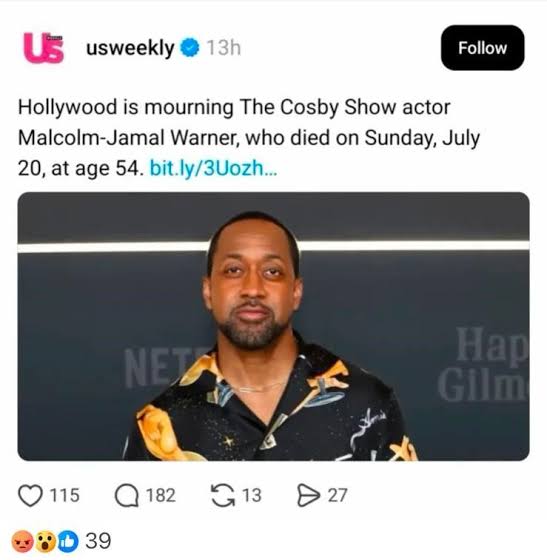
Jaleel had to call it out himself. While grieving a man he was close to.
My first thought was AI. Google had been putting AI into search for over a year by then, so it felt like the obvious answer.
But then I stopped myself.
Could a writer have searched his name and grabbed an image that was mislabeled somewhere online?
Could a photo library have had the wrong name attached for years?
Was somebody rushing to be first with breaking news?
Then I looked closer at the background. Netflix. Happy Gilmore.
That photo appears to be from the Happy Gilmore 2 premiere in New York on July 21, the day after Malcolm passed. Jaleel was there, and reporters asked him about Malcolm that night.
So the most likely answer might not be AI at all. It might be a fresh photo from coverage of Jaleel’s reaction, attached to the wrong post.
I still can’t prove it. And honestly, that’s the lesson.
Because whether a person made that mistake or a machine did, somebody built the process that let it happen.
I don’t want to jump to a conclusion and automatically declare every mistake an example of racial bias.
But I absolutely want to investigate whether bias played a role.
Because that’s how we learn.
And that’s what I want our students to learn.
The ability to recognize that something might be wrong is important.
But the ability to investigate why it’s wrong?
That’s where things get interesting.
The Opportunity Divide Doesn’t Disappear Because We Have AI
In August, I came across an article in the Atlanta Journal-Constitution’s Get Schooled series titled “AI will worsen racial disparities it didn’t create.”
It was written by Shaun Harper, a USC professor and founder of the National AI Equity Lab.
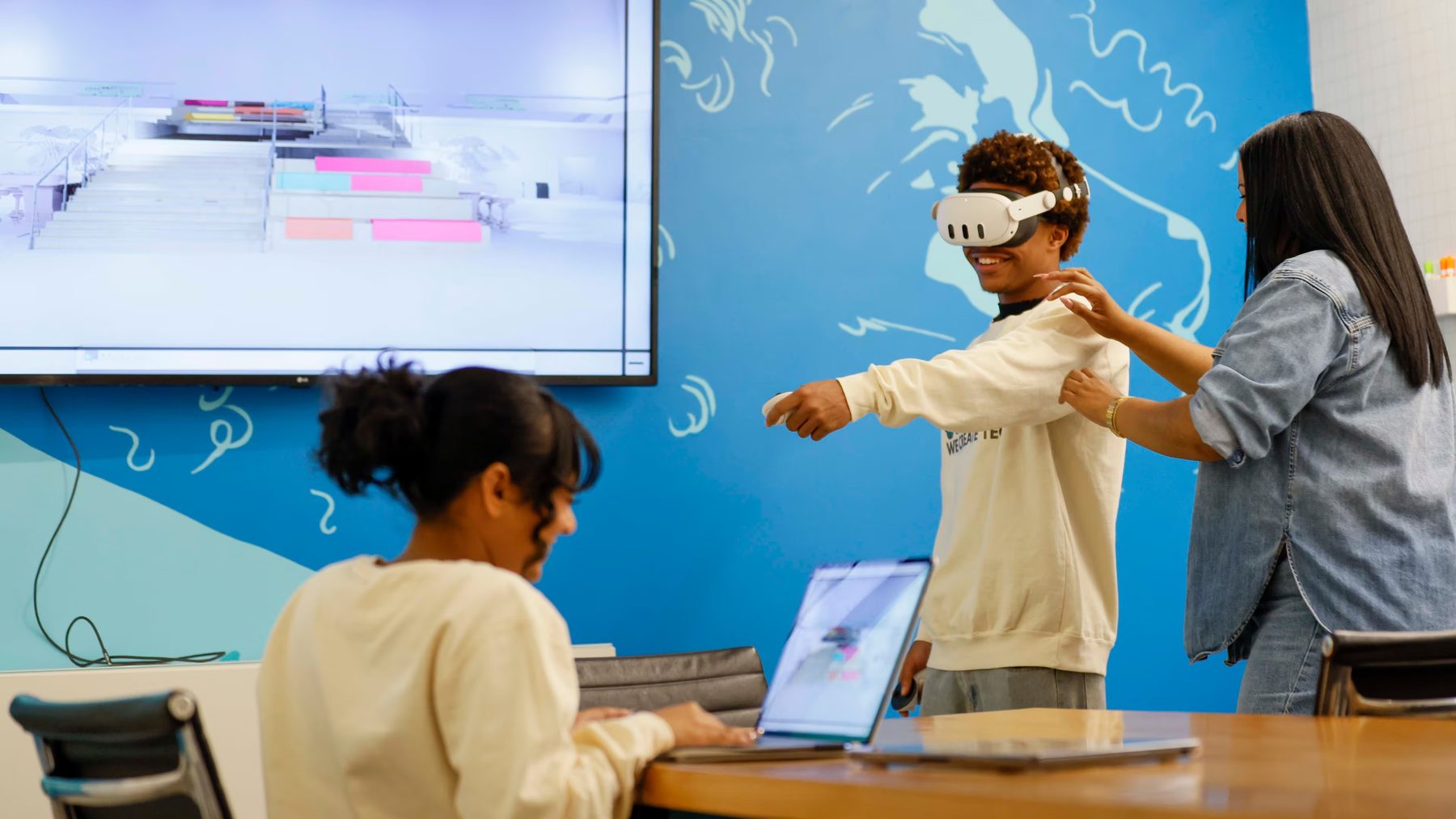
And when I opened it, the photo at the top was me, working alongside our students during a VR class.
I wasn’t expecting that. But it made one thing clear: the work we do every day is already part of this conversation.
And let me tell you, it made me think.
Because we’ve been talking about the opportunity divide for years at We Create Tech. Long before everybody started talking about ChatGPT.
Now we’re watching another technological revolution happen right in front of us.
And I keep asking myself, are we going to repeat the same mistakes?
Are we going to wait until these technologies are everywhere before we start asking whether our children have the knowledge and opportunities to participate?
Or are we going to do something about it now?
What stood out to me about Harper’s article was his argument that AI didn’t create the inequalities we’re worried about.
Those inequalities were already here.
And he’s right about something important.
As he puts it:
“Algorithms are artificial. Racial inequities are not.”
Technology doesn’t exist in a vacuum.
People build these systems.
People make decisions about what information goes into them.
People decide who gets access.
Harper writes specifically about Black students, and he’s clear that they cannot, once again, be the last to receive the technologies their peers have been benefiting from for years.
I agree.
But here’s where I want to push the conversation further.
Access is one piece of the opportunity divide. It is not the whole thing.
A student can have a laptop, a login, and every AI tool on the market and still never be invited to question what those tools are telling them.
That’s why I believe our responsibility goes beyond putting technology in front of children.
We have to prepare them to question it, understand it, and eventually help build it.
And that’s exactly what we’re working toward at We Create Tech.
Read Shaun Harper’s AJC Get Schooled article
This Is Real Life, Y’all
On January 7th, during an AI literacy session at the Best Buy Teen Tech Center, we started with a conversation.
Before students ever opened Google’s Teachable Machine, I wanted to understand how they were already interacting with artificial intelligence.
Were they using it?
Did they trust it?
Had it ever given them information that wasn’t accurate?
I started asking questions and encouraging them to share examples.
And that’s when one student spoke up.
He had used AI to help with his math homework, and it had gotten all his problems wrong.
You can actually hear him in the background of our video saying:
“Yeah, ‘cause it got all my math problems wrong.”
Watch our January 7 AI literacy lab
And I remember explaining to the students something along these lines:
“This is real life, y’all. You’ve got to question things. It doesn’t matter if it’s AI or not.
That’s just like if you’re standing outside, it’s cloudy, it’s raining, and somebody walks up to you and tells you the sun is out. You just can’t see it.
Are you really gonna believe them?”
Because think about that.
Why would you accept something as true simply because somebody told you?
And why should that change because the information came from a computer?
After our discussion, we moved into Teachable Machine.
I deliberately had the students work with everyday objects rather than their faces because we didn’t have parental permission to use their images.
The goal wasn’t to create something flashy.
I wanted them to understand foundational concepts.
Imagine training a model to recognize a black wallet.
You show it examples. You give it information. You teach it what you’re asking it to identify.
But what happens when somebody walks into the background?
What happens when the lighting changes?
What happens when another object appears beside it?
Does the model still recognize the wallet?
Or has it learned to associate the wallet with other things appearing in the image?
And how would we know?
We test it.
We change something.
We observe what happens.
We ask another question.
Now we’re learning.
Not just how to use technology, but how to examine it.
Introducing Prove It
This is exactly why we’re developing Prove It, our AI literacy methodology at We Create Tech.
Our tagline is simple:
Don’t just ask AI. Challenge it.
Prove It moves students through four steps:
Ask. Start with a meaningful question and look at what AI says about it.
Investigate. Gather your own evidence through research, experiments, interviews, and hands-on testing.
Compare. Hold the AI’s answer up against what you found. Where does it agree? Where does it contradict? What can’t it support?
Decide. Reach your own conclusion, and be ready to defend it.
I don’t want students walking away from our programs believing that an answer must be correct because artificial intelligence generated it.
I want them to question the output.
Look for evidence.
Test what they’re being told.
Consider what might be missing.
And determine what they can actually verify.
Because AI literacy cannot stop at teaching young people how to write prompts.
They need to understand that these systems have limitations.
They need to recognize that information can be incomplete, inaccurate, or biased.
And they need opportunities to investigate those problems themselves.
Prove It is our way of helping students develop those habits of mind through guided inquiry, hands-on experimentation, and evidence-based reasoning.
Remember that black wallet? That’s Prove It in action. Ask. Investigate. Compare. Decide.
And listen, I’m learning in real time, too.
I don’t pretend to know everything about artificial intelligence.
I have prior knowledge. I have experience. I know how to introduce concepts and facilitate learning.
But I don’t want students looking at me as somebody who is all-knowing.
We’re figuring some of these things out together.
And I want them to take what we introduce and go further.
That’s the goal.
I Don’t Mind Being Phil Jackson
Anybody who knows basketball understands what I’m saying when I tell you this.
I don’t mind my team and me being Phil Jackson.
We want these students to become the Michael Jordans and Scottie Pippens of their generation.
We’re here to coach.
Challenge.
Encourage.
Give them the tools.
Help them understand the fundamentals.
But ultimately, they’re the ones who have to take it down the court.
And I want them to take it further than we ever imagined.
That’s what education should do.
It should create opportunities for young people to surpass what we know.
Not simply repeat what we’ve taught them.
The Opportunity We Cannot Afford to Miss
There are important conversations happening about artificial intelligence right now.
Its environmental impact.
Its ethical implications.
Its potential to displace workers.
Its ability to reproduce existing inequalities.
Those conversations matter.
We should absolutely be having them.
But while adults are debating what AI might do to society, I keep thinking about the young people who are growing up in a world where these systems are already becoming part of their everyday lives.
Who is preparing them?
Who is giving them the opportunity to question these systems?
Who is helping them understand how the technology works?
And perhaps most importantly, who is encouraging them to become the people who build what comes next?
I think about Caden.
I think about that student who realized AI had gotten his math problems wrong.
And I think about how both experiences represent something important.
One student needed an opportunity to discover what he was capable of creating.
Another needed an opportunity to recognize that technology wasn’t always right.
Both needed an environment where their thinking mattered.
That’s the connection.
And that’s the work.
Keep Opening Doors
I don’t know everything about artificial intelligence.
But I do know something about opportunity.
I know what happens when somebody sees something in a child that other people have overlooked.
I know what happens when young people are given room to question, experiment, fail, figure it out, and try again.
And I know what happens when somebody opens a door.
That’s why I keep showing up.
That’s why we built We Create Tech.
And that’s why I hope the students who come through our programs eventually go further than we ever imagined.
Because when they get there?
I hope they remember to open the door for somebody else.
Toni Morrison said it beautifully:
“If you have some power, then your job is to empower somebody else.”
Keep showing up. Keep creating opportunities. Keep opening doors.
Shana Sanders
Founder & CEO, We Create Tech